
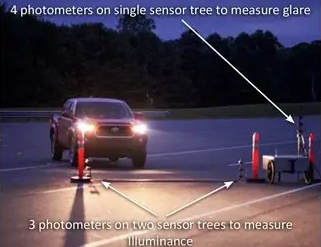
The National Highway Traffic Safety Administration (NHTSA) has introduced a new regulation under Federal Motor Vehicle Safety Standard (FMVSS) No. 108 permitting Adaptive Driving Beam (ADB) headlamp systems in vehicles sold in the U.S. This rule introduces a new testing framework that diverges sharply from the existing Insurance Institute for Highway Safety (IIHS) protocol, emphasizing scenario-based glare testing, absolute illuminance thresholds, and tighter tolerances for vehicle speed, response timing, and track levelness.
The Illumina Tramp headlight testing system, originally developed for IIHS compliance, is uniquely positioned to support this regulatory shift. Built around a real-time data acquisition architecture with synchronized GPS timing and high-fidelity photometric sensors, the system can be upgraded through software enhancements rather than hardware changes. These enhancements support NHTSA’s absolute evaluation methods, while preserving compatibility with IIHS’s dynamic scoring approach.
Critically, the system’s photometric sensors exceed NHTSA’s minimum requirements for spectral fidelity and cosine response, reducing measurement uncertainty and improving confidence in compliance testing, especially when outcomes depend on small illuminance differences.
Recognizing ongoing industry uncertainty regarding the permanence and interpretation of the NHTSA ADB regulation, this white paper presents a forward-compatible testing framework. It outlines how the Illumina Tramp system supports both current and anticipated regulatory protocols through modular, software-defined enhancements while maintaining a high level of accuracy, repeatability, and confidence in test results.